
How we redesigned liquidity provision for the #1 DEX on TON and made the most complex protocol upgrade accessible for every user
STON.fi is a decentralized cross-blockchain platform (DEX) and Automated Market Maker (AMM) natively built on the TON blockchain.











Challenge
Ship the most technically complex protocol upgrade in the product’s history while making liquidity provisioning and farming accessible to a broader audience to drive conversion rate (CR).
Results
430K MAU
+10% CR liquidity provision into V2 pools
+15% into all platform trading volume through V2 pools
−10% liquidity provision (LP) support tickets
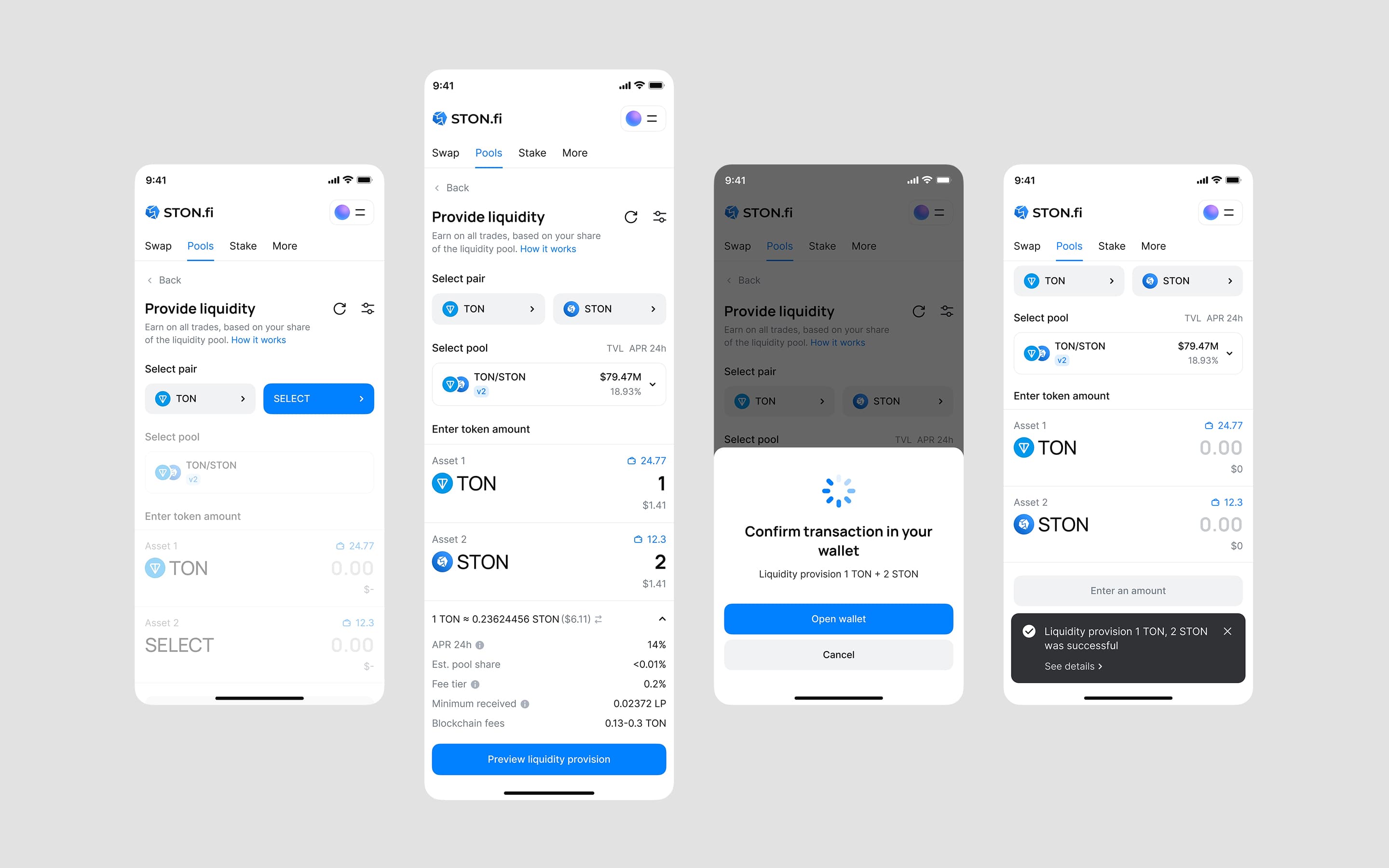
Couple screens from the whole scenario
Context
A DEX gives users access to early and niche tokens — swapping digital assets directly from their wallet, without third parties or the KYC process mandatory in traditional finance.
Behind swaps sits Liquidity Provision, where users lock a pair of assets (like TON and USDT) and earn a share of every swap fee from that pair — and Farming, which lets users stake their token pair position into additional reward programs (the DeFi equivalent of a certificate of deposit).
Farming and liquidity have a high entry barrier and are popular only among advanced users.
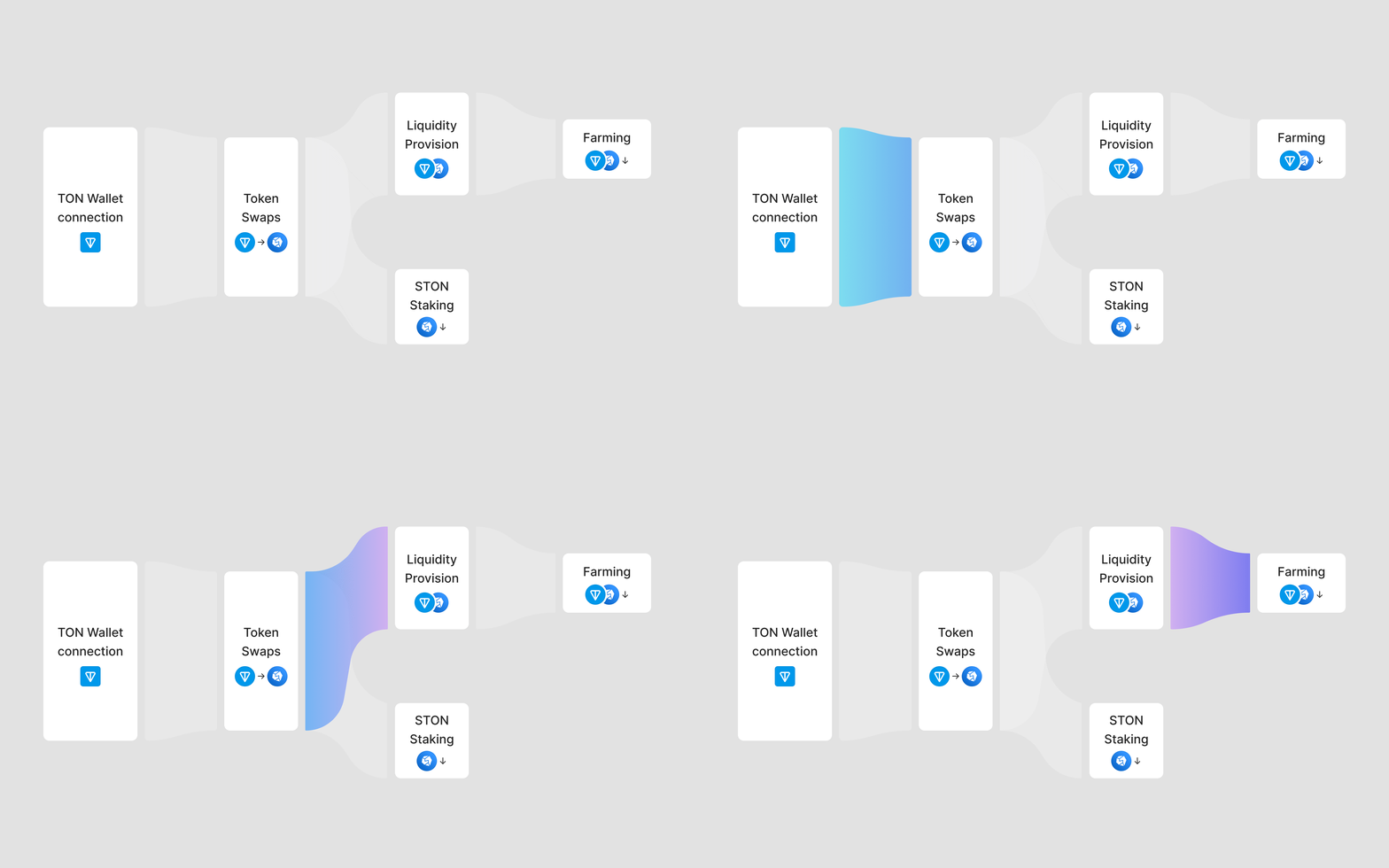
High-level DEX user journey and conversion funnel
 Interesting fact
Liquidity provision is the DeFi equivalent of market-making
On a traditional exchange, liquidity provision is reserved for institutions. In DeFi, anyone can do it: deposit tokens into a pool and earn a fee on every swap that flows through it.
STON.fi V2 took it further — single-sided deposits and farming in one flow. Fewer steps mean more users complete the journey. More liquidity in pools, more positions held longer — higher TVL and more protocol revenue.
Audience segments
- Liquidity providers and yield farmers who want more flexibility and control over their positions to earn more financial returns.
- Telegram-native and mass-market users who discovered DeFi through the TON ecosystem and need a simple, guided experience to take their first step beyond basic token swaps.
User problems
- Users who want to earn yield don't understand how liquidity provision works and are afraid of making mistakes that cost them money.
- Professional traders need more flexible position control than V1 allowed.
- Too many error alerts caused by blockchain-level technical constraints created confusion and distrust in the interface.
- The visual similarity between the Swap and Liquidity forms occasionally leads to wrong data entering.
Business problems
- Low LP adoption limited TVL growth, reducing trading volume and protocol revenue.
- Low conversion (CR) into liquidity provision and farming due to a complex, multi-step flow in V1, resulting in low trading volume and TVL.
- High support load from LP transaction errors drove operational costs and damaged user trust.
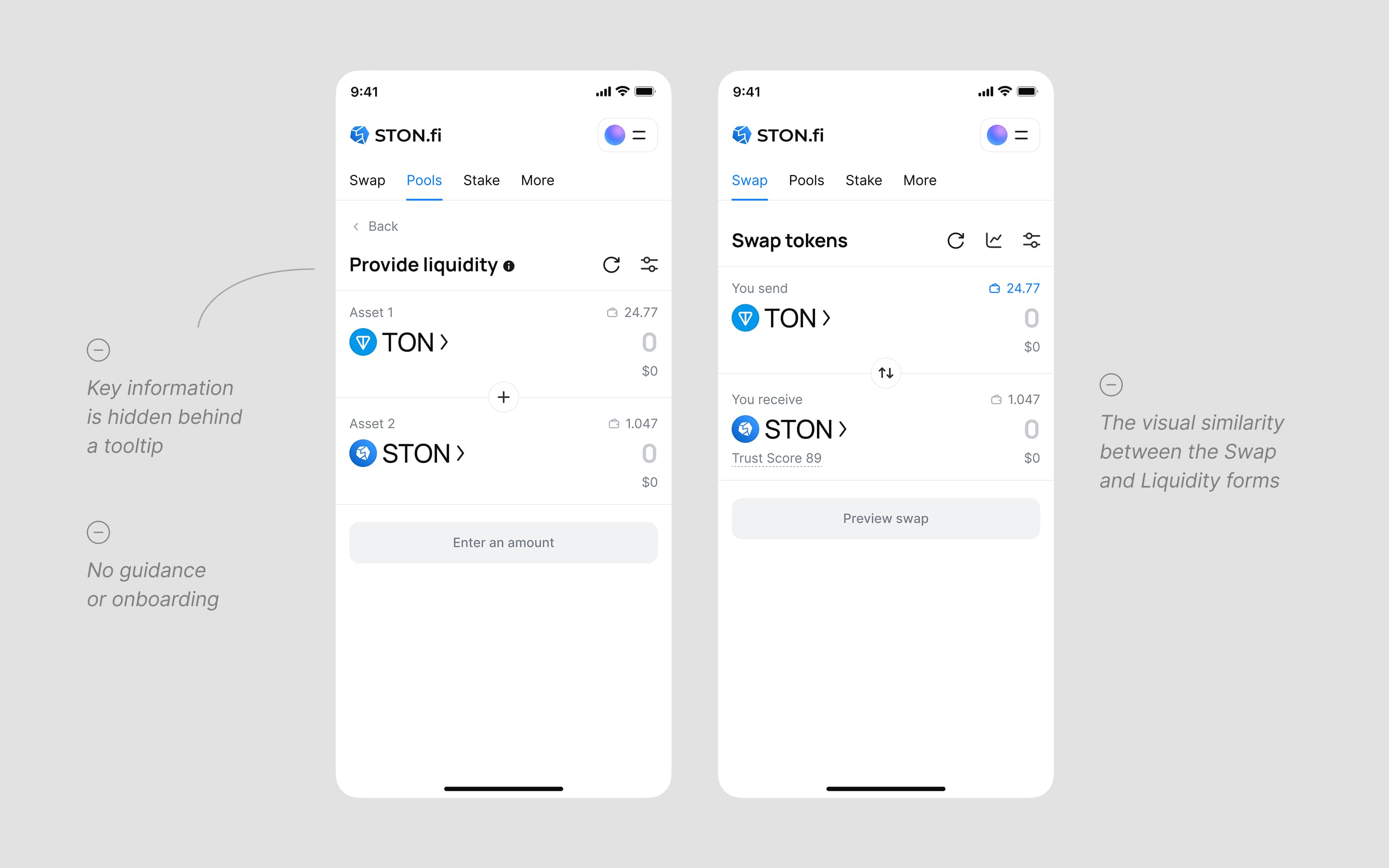
Part of the V1 UX audit
First things first: making sense of the complexity
First: consolidate everything. Then define the scope — release by release. What ships in the first release, what comes next, what needs to be accounted for now even if it's built later. Everything lands in one structured file — a shared source of truth for design and engineering before jumping into wireframing.
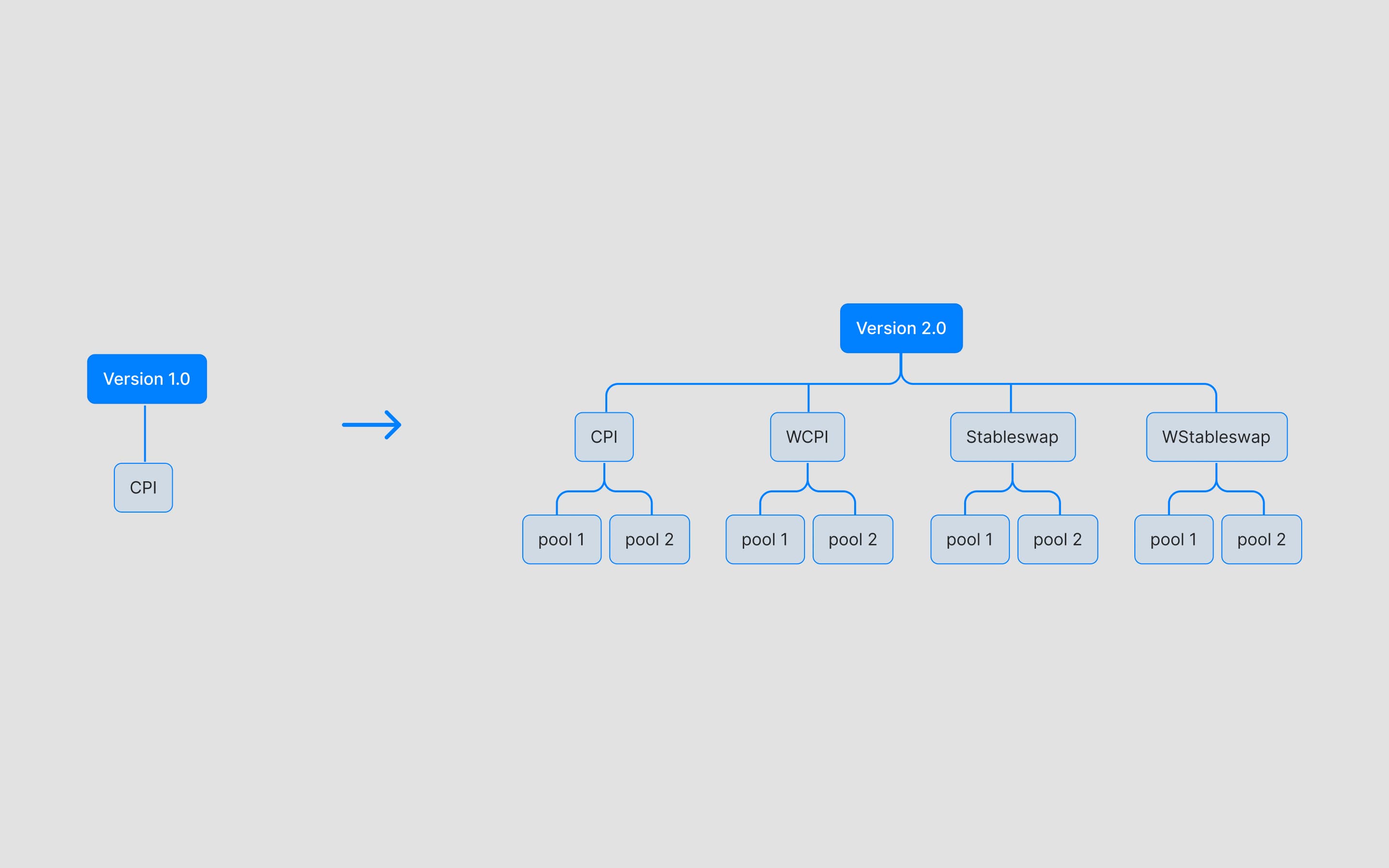
High-level overview of the technical changes
Market research and UX audit
We audit DEXes across the market spectrum, mapping every step of the LP provision flow: Uniswap, Zapper, Beta, and others. There are no similar products on the market. Still, we identify recurring UX patterns — the traps to avoid and the solutions worth borrowing.
Interesting factWeb3 treats complexity as a feature
The unspoken assumption: advanced users will figure it out. But the crypto user base isn't infinite — and growth requires making DeFi legible to people who aren't already experts. That's Tesler's Law in practice: complexity doesn't disappear, it just shifts from the user to the product team.
- What we took: wizard pattern, surfacing V2 pools as the obvious default, fewer steps with clearer outcomes at each one.
- What we left behind: technical jargon without explanation, features hidden behind docs, pool selection logic dumped entirely on the user, errors without clear user guidance.
UX audit overview
Hypotheses
- If we implement a wizard flow, we will reduce user friction and increase conversion into liquidity provision.
- If we integrate farming directly into the LP flow with APR and APY displayed at the point of decision, users will be more likely to activate farming immediately, increasing TVL.
- If we add contextual tooltips during liquidity providing flow, we will reduce dependency on external documentation and lower support ticket volume from new LP providers.
- If we surface a smart recommendation when a user selects a low TVL/APR pool, we will guide users toward better-performing pools and increase overall protocol liquidity depth.
UX challenges
- Transform technically complex feature scope into a smooth, intuitive user journey.
- Ensure a seamless pool transition for existing users who had active liquidity positions in V1 pools.
- Identify and cover all corner cases introduced by new pool mechanics and provision modes.
- Introduce new UI components and integrate them consistently into the existing design system.
- Develop interface copy that turns technical DeFi terminology into clear, benefit-driven language for non-expert users.
Wireframing and usability tests
In a team session, we land on a flow where the user first selects the liquidity pool version — a decision driven by technical constraints. Early usability tests with less experienced users reveal that they get lost at the v1/v2 selection step. On top of that, the version filter obscures a large portion of available pools from view. What users actually care about first is the token pair and the farming yield on it. We also discover that most users don't know what farming is or why it matters. We take that feedback seriously, step back, and rethink the entire flow.
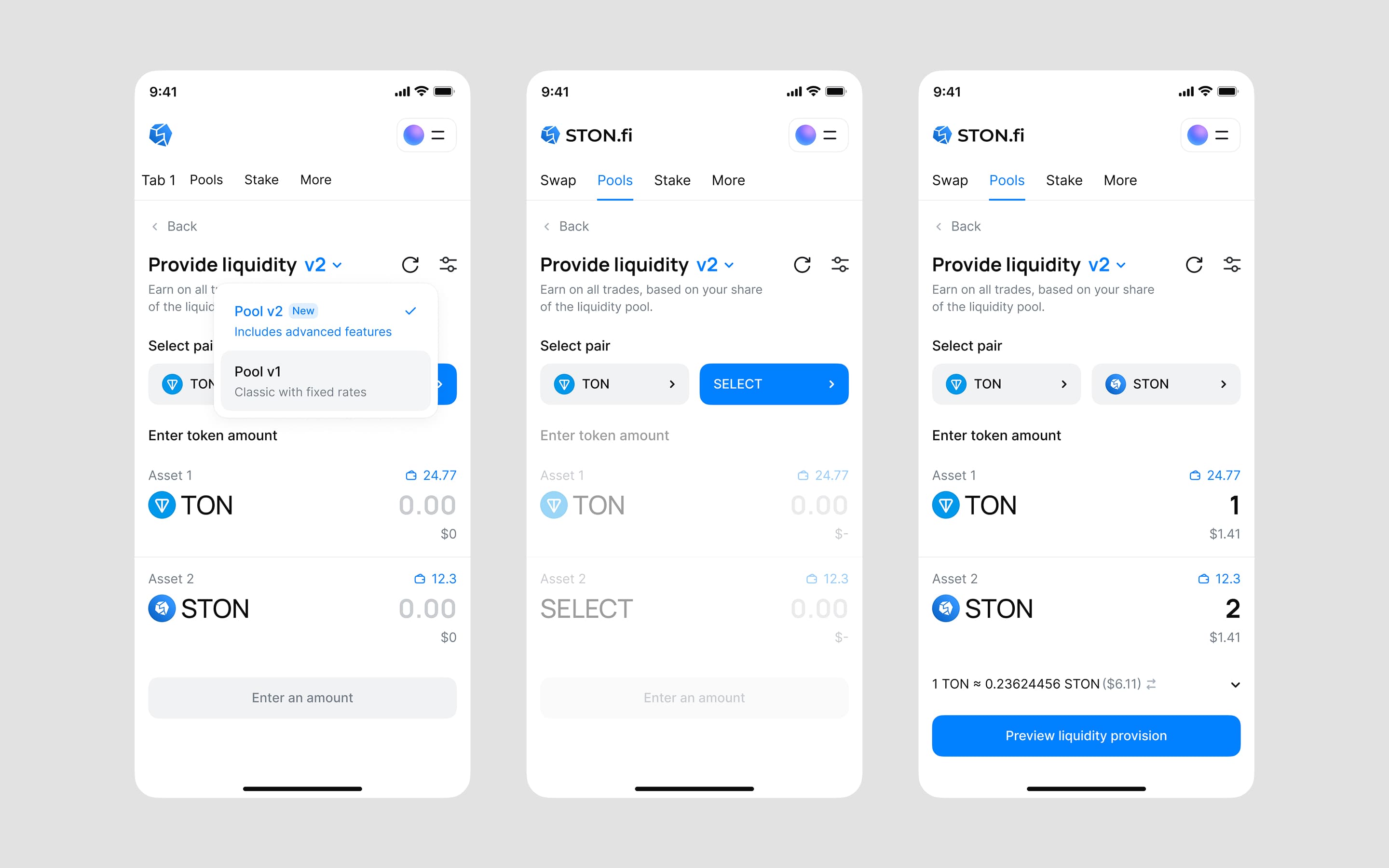
Iteration 1
After a brainstorm with the engineering team, we move all technical complexity behind the scenes and cut unnecessary steps, simplifying the flow further.
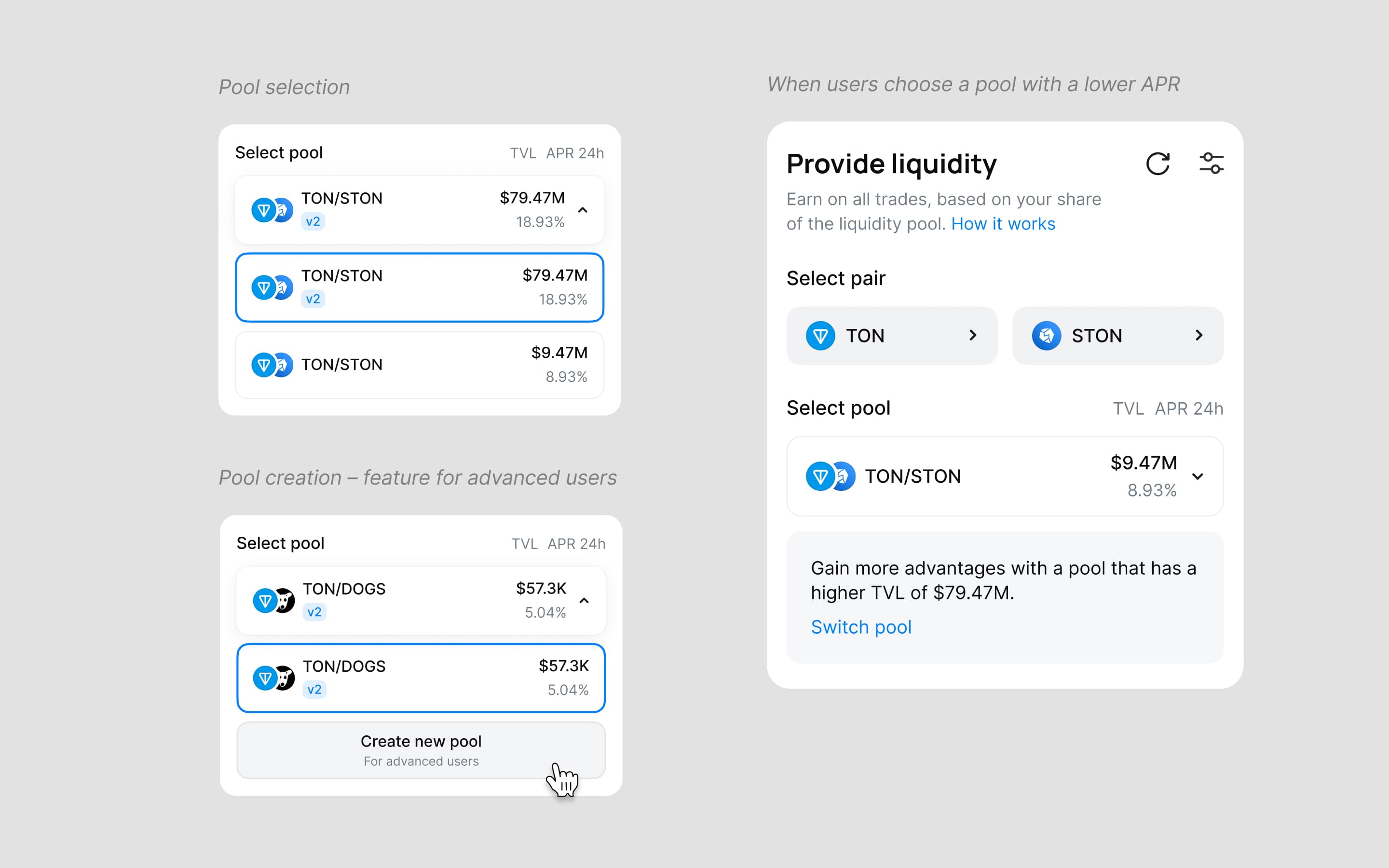
On the pool selection page, we highlight the new pools and add a tooltip to the existing Farm label — keeping Tesler's Law in mind: some complexity has to live somewhere. We bring AI tools into the copy workflow — cutting that step down significantly.
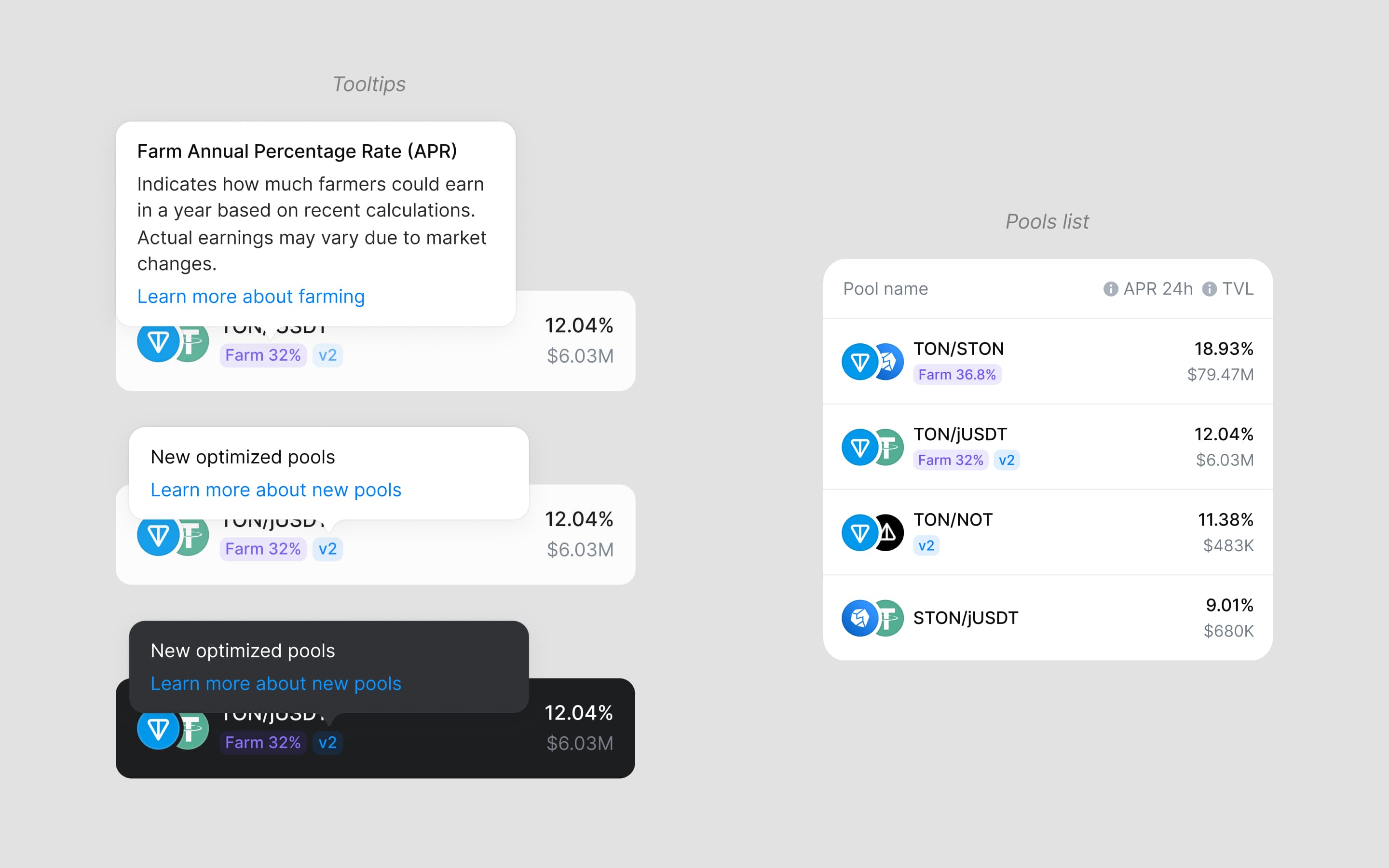
Tooltips on the pool list page
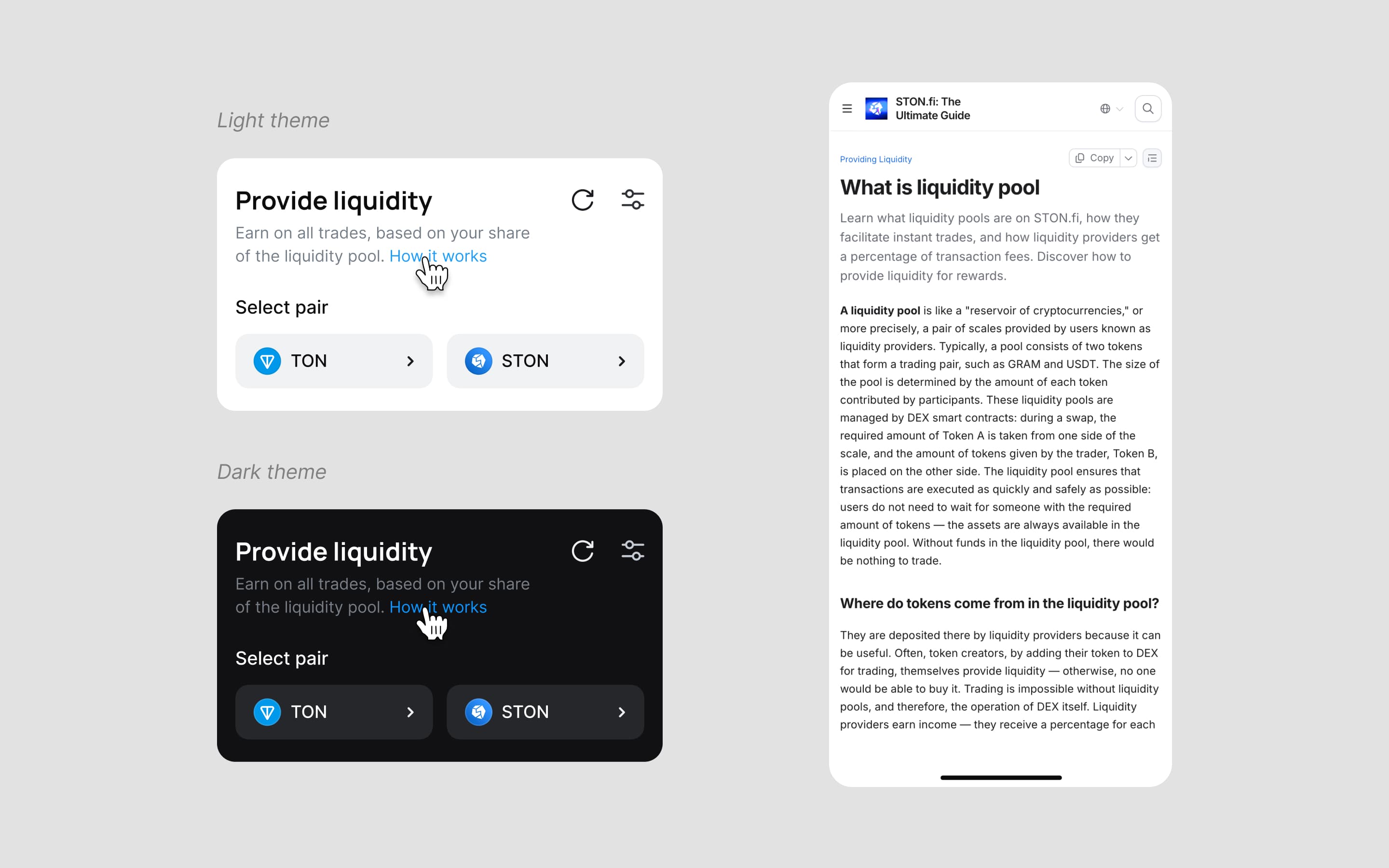
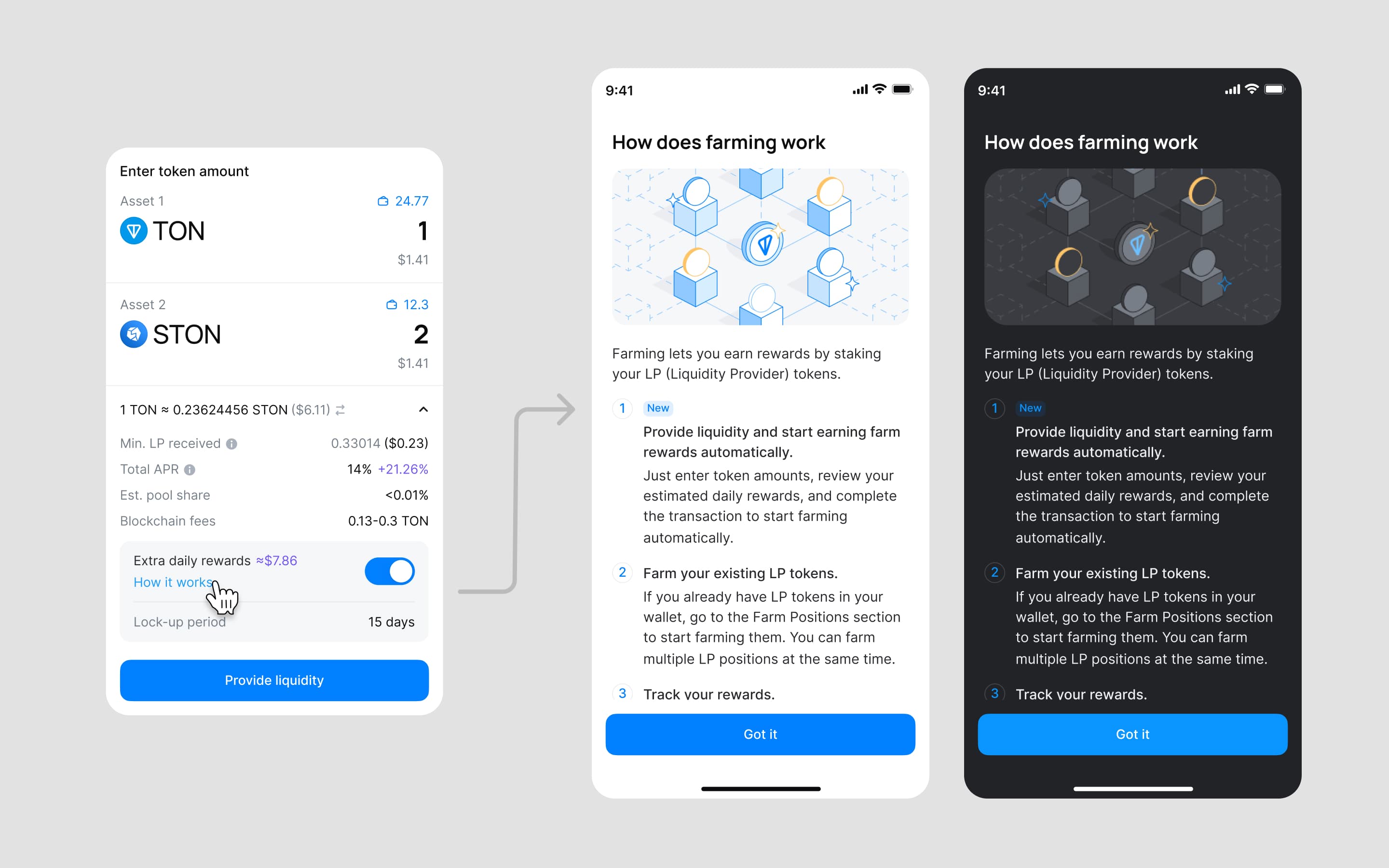
As part of onboarding, we add a link in the form description pointing users to a guide that answers their most common questions.
If a user arrives from the pool page, the token pair is pre-selected. If not, the first token defaults to TON — the base asset for all transactions — and we prompt them to select a second token to continue.
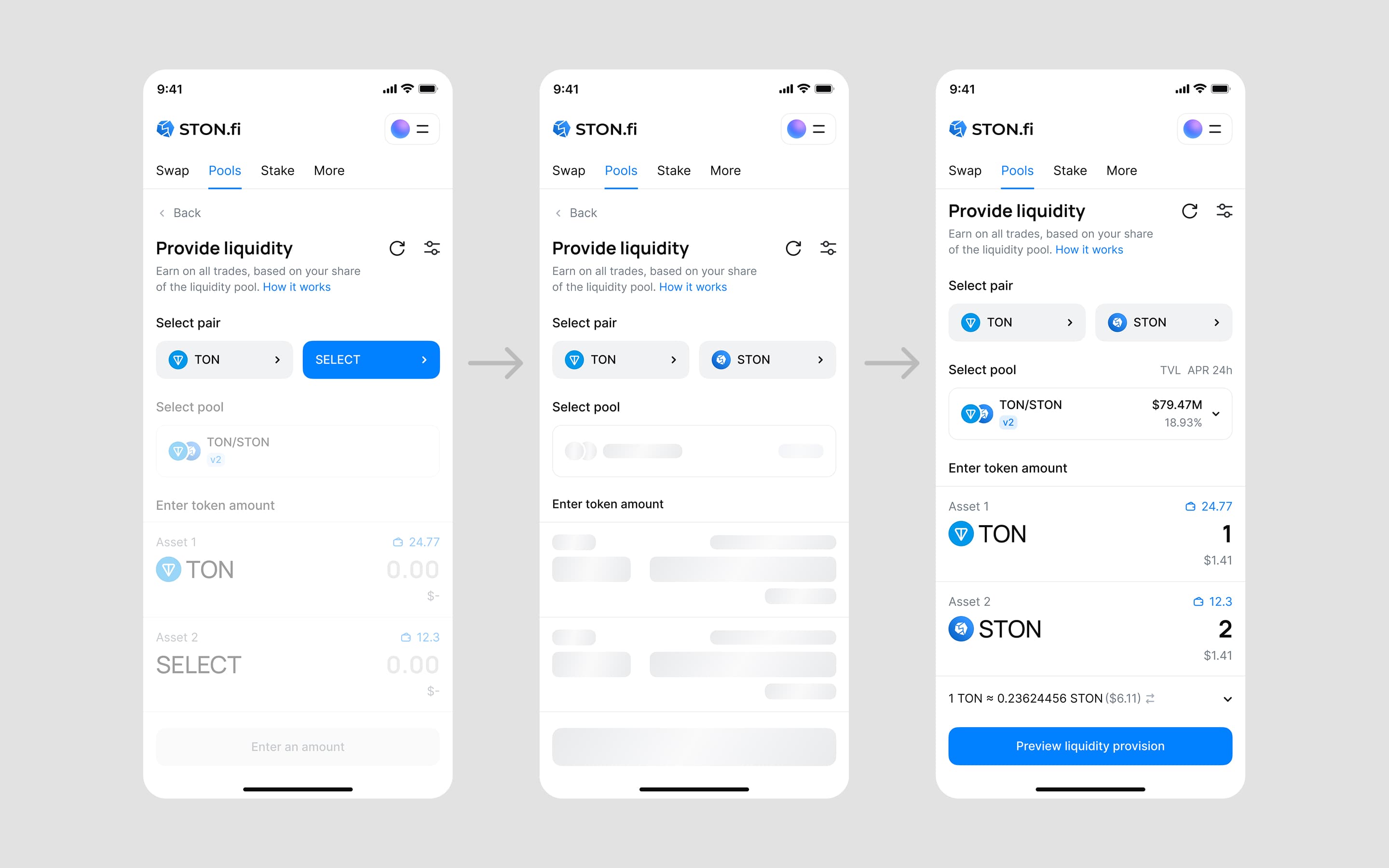
Once the second token is selected, we surface the highest-yield pool automatically.
If a user somehow lands in the liquidity form with a lower-yield pool already selected, we surface a smart recommendation pointing them to the better-performing option.
As the final touch, we embed a farming card directly into the liquidity form — combining liquidity provision and farming into a single transaction to drive conversion into farming. For onboarding, we add a modal that walks users through each step.
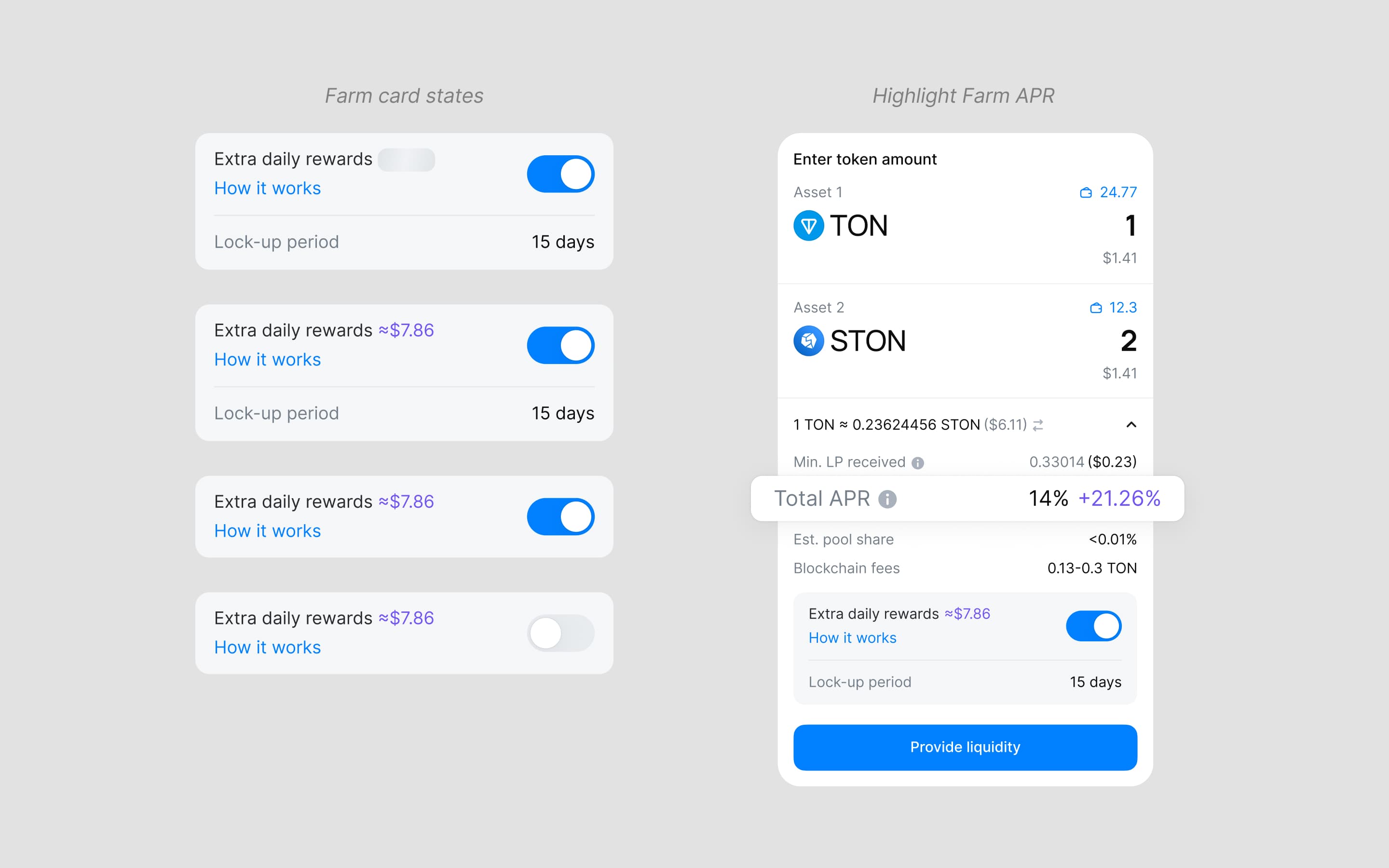
When farming is available in the selected pool, we auto-enable the toggle. We make the APR change explicit — so users immediately see how their yield improves.
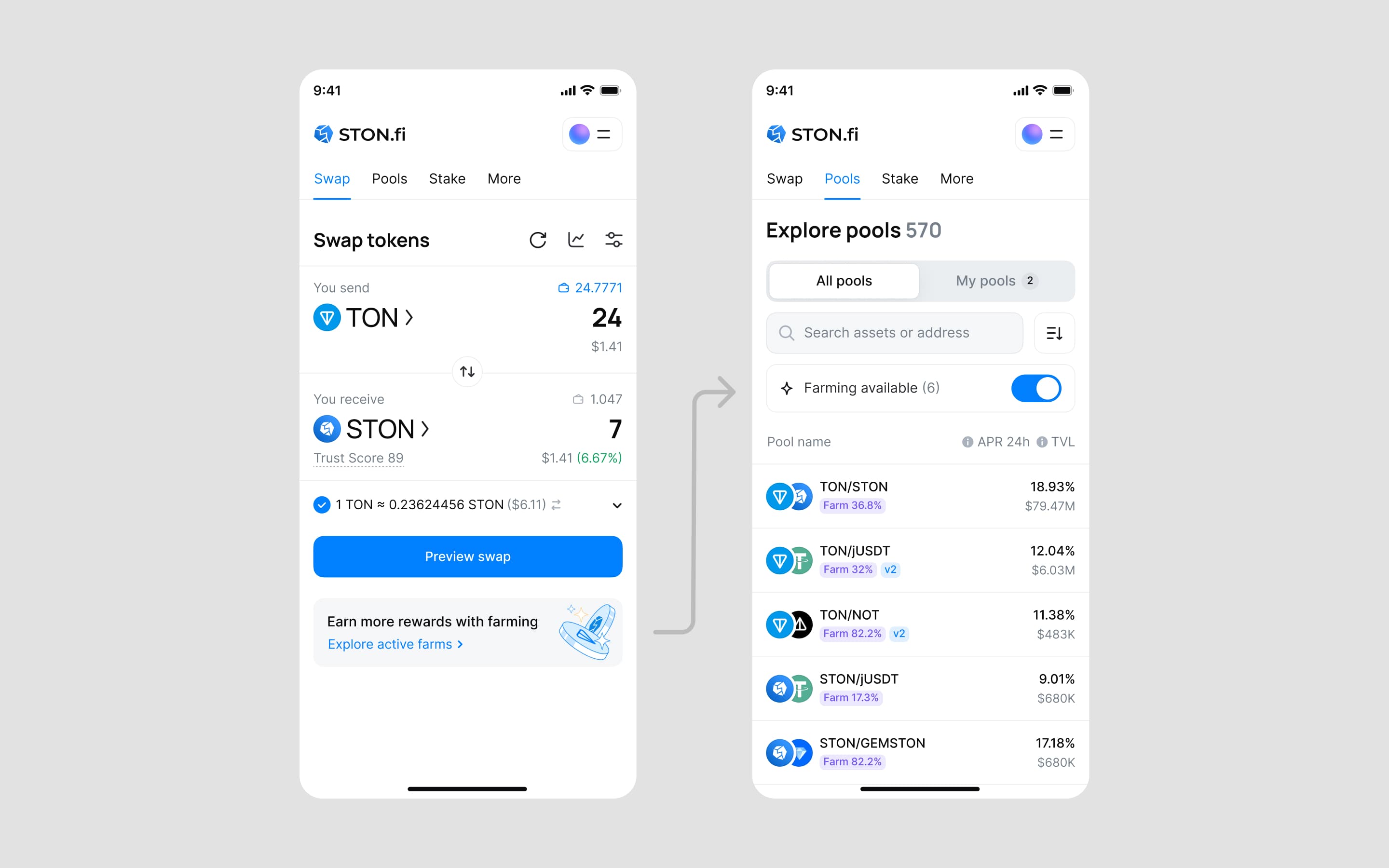
We can’t meaningfully grow anything without an entry point on the main screen.
As a final step, I run all in-product copy through AI tools to check grammar and punctuation.
From there, we assemble the full flow with all states, animations, and specs for a clean handoff to engineering.
Final layouts with full user flow and specs
Results
STON.fi Version 2.0 was the largest protocol upgrade in the product’s history, introducing four new pool architectures and a redesigned liquidity experience. Following the launch, the platform reached $370M in TVL and surpassed 4.3M+ unique swappers across the TON ecosystem, strengthening its position as the leading DeFi protocol on TON.
The release gained broad industry recognition, with coverage from Cointelegraph, Binance Square, DWF Labs Research, TechFlow, GetBlock, and official TON ecosystem channels.
Beyond the business impact, the redesign significantly improved usability and established a scalable foundation for future STON.fi releases and liquidity features.
Other cases
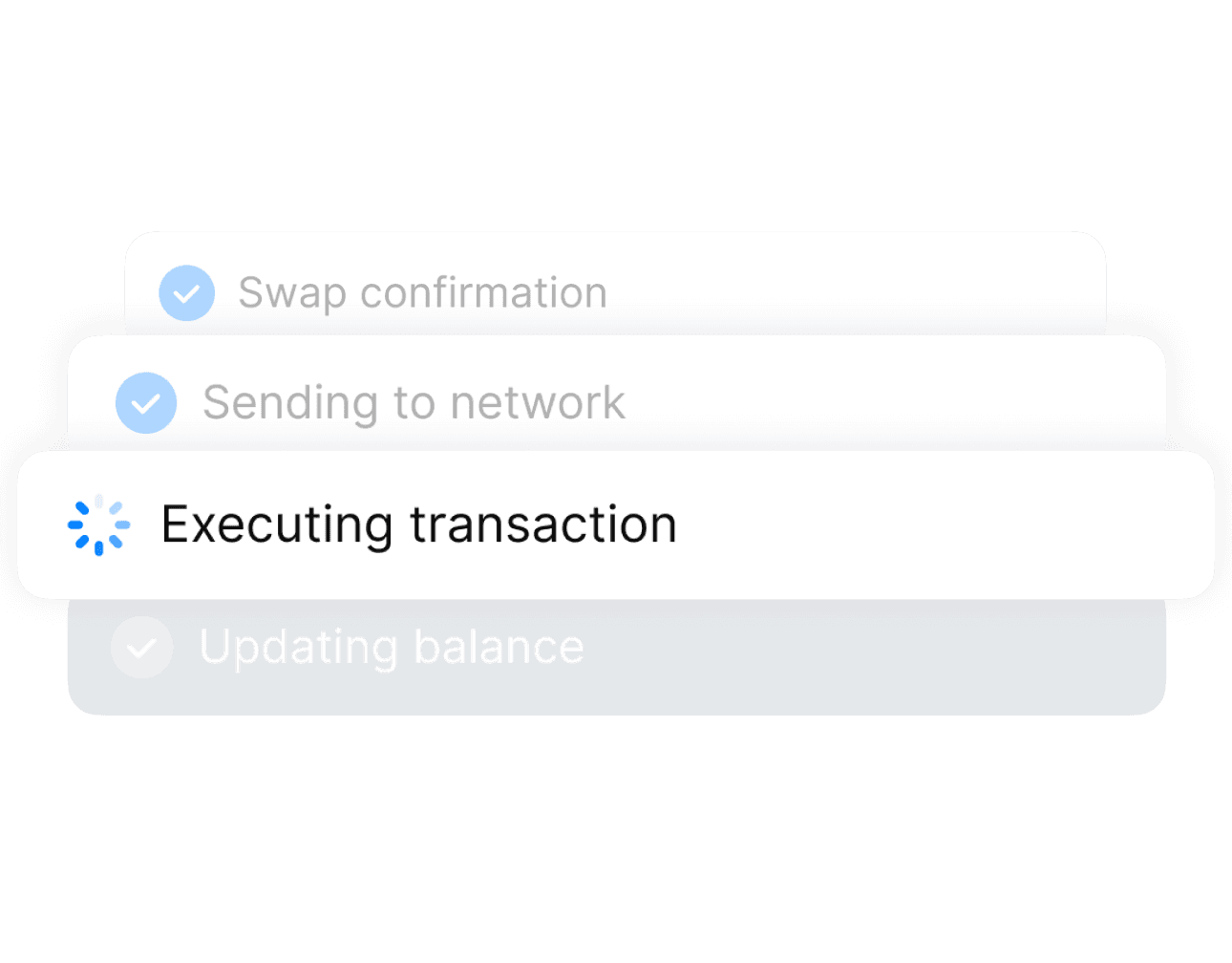
Clear transaction statuses on STON.fi
How we provided transparent communication and reduced support requests by 30%.
Product Design Lead,
2024
Evearn App redesign
How we came up with new concept and full app rebranding for couple weeks.

Senior Product Designer,
2025
